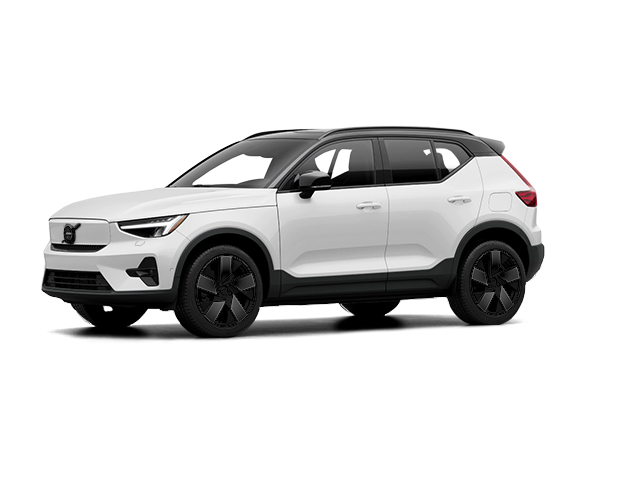
Photo for illustrative purposes only.
Find out moreVolvo Cars Mississauga


The XC40 platform offers two distinct powertrain approaches built on identical compact SUV architecture. The XC40 B5 AWD pairs a turbocharged engine with a 48-volt mild hybrid system, while the EX40 eliminates combustion entirely in favour of battery-electric propulsion. Both deliver Volvo's safety standards and premium interior quality, but they serve different driving patterns and infrastructure realities across Ontario.
Understanding which powertrain suits your circumstances requires examining range capabilities, refueling logistics, performance characteristics, and operating costs over a typical ownership period. The choice depends less on abstract preferences and more on practical considerations: daily mileage, access to charging, and the frequency of trips beyond the Greater Toronto Area.
At a Glance: XC40 B5 AWD vs. EX40
|
Feature |
XC40 B5 AWD |
EX40 Single Motor |
EX40 Twin Motor |
|---|---|---|---|
|
Powertrain |
2.0L turbo + 48V mild hybrid |
Electric motor (RWD) |
Dual electric motors (AWD) |
|
Power Output |
247 hp |
248 hp |
402 hp |
|
Torque |
258 lb-ft |
310 lb-ft |
494 lb-ft |
|
0-100 km/h |
6.4 seconds |
7.3 seconds |
4.8 seconds |
|
Range |
~600 km (54L tank) |
476 km |
418 km |
|
Fuel/Energy Economy |
9.1 L/100 km combined |
2.2 kWh/100 km combined |
2.5 kWh/100 km combined |
|
Towing Capacity |
1,600 kg |
900 kg |
900 kg |
|
Cargo Space (seats up) |
569 L |
578 L |
578 L |
|
Cargo Space (seats down) |
1,319 L |
1,328 L |
1,328 L |
Powertrain Architecture and Operation
The XC40 B5 AWD uses a 2.0-litre turbocharged four-cylinder engine producing 247 hp and 258 lb-ft of torque. The mild hybrid system consists of a 48-volt battery and an integrated starter-generator (ISG) rated at 13 hp. This ISG recovers energy during braking and assists the engine during acceleration, reducing fuel consumption by smoothing power delivery and eliminating turbo lag.
The system does not provide electric-only driving. Instead, it supplements the combustion engine to improve efficiency and responsiveness. The 48-volt architecture powers the ISG and allows for engine stop-start operation at traffic lights without the lag associated with traditional 12-volt systems. The technology reduces combined fuel consumption to 9.1 L/100 km while maintaining full AWD capability through a conventional eight-speed automatic transmission.
The EX40 eliminates the combustion engine and transmission entirely. The Single Motor variant places a 248 hp electric motor on the rear axle, delivering 310 lb-ft of torque in a rear-wheel-drive configuration. The Twin Motor variant adds a second motor to the front axle, creating an all-wheel-drive system with combined output of 402 hp and 494 lb-ft.
Both EX40 variants use a 79 kWh usable battery pack mounted in the floor, providing a low centre of gravity. The Single Motor achieves 476 km of range under Natural Resources Canada testing, while the Twin Motor's increased power consumption reduces range to 418 km. The EX40 supports DC fast charging at up to 200 kW, enabling 10-80% charge in approximately 28 minutes at compatible stations.
Range and Refueling Logistics
The XC40 B5 AWD provides approximately 600 km of range from its 54-litre fuel tank, based on the combined fuel economy of 9.1 L/100 km. Refueling takes five minutes at any gas station. For Hamilton drivers making frequent trips to Toronto, Niagara, or cottage country north of Barrie, this unlimited range removes planning requirements. The vehicle operates identically in all weather conditions, with no range reduction in winter.
The EX40 Single Motor's 476 km range covers most single-day travel within Ontario without charging. A Hamilton resident commuting to downtown Toronto (approximately 70 km round trip) can complete an entire work week on a single charge. However, trips to Ottawa (900 km round trip) or extended cottage visits require charging stops, which adds 30-45 minutes to travel time depending on charger availability and speed.
Winter weather significantly affects electric vehicle range. Cold temperatures reduce battery efficiency and increase energy consumption for cabin heating. In typical Ontario winter conditions, drivers should expect the EX40's range to decrease by 30-40%. This reduces the Single Motor's effective winter range to approximately 285-333 km, and the Twin Motor's to approximately 251-293 km. The XC40 B5 AWD experiences no such reduction, maintaining full range regardless of temperature.
Home charging infrastructure determines the practicality of EV ownership for many buyers. The EX40 requires a 240-volt outlet for Level 2 charging, which delivers a full charge in approximately eight hours using a 48-amp charger. Installation costs for home charging equipment typically range from $1,000-2,500 depending on electrical panel capacity and distance from the parking location. Buyers renting properties or living in condominiums may face restrictions on charging equipment installation.
Performance and Driving Characteristics
The XC40 B5 AWD delivers linear power delivery typical of turbocharged engines. The mild hybrid system fills the brief lag between throttle application and turbo boost, creating more responsive acceleration than non-hybrid turbocharged vehicles. The eight-speed automatic transmission shifts smoothly, and the AWD system distributes torque between front and rear axles based on traction conditions.
The EX40 Single Motor provides instant torque delivery characteristic of electric motors. Acceleration from a stop feels more immediate than the B5, despite similar 0-100 km/h times. The absence of transmission shifts creates seamless acceleration, though the rear-wheel-drive configuration can experience wheel spin on slippery surfaces when accelerating aggressively from a stop.
The EX40 Twin Motor transforms the vehicle's character entirely. The 4.8-second 0-100 km/h time makes this among the quickest compact SUVs available, regardless of powertrain. The dual-motor AWD system provides traction in all conditions, distributing torque instantly between axles based on available grip. For drivers who prioritize performance, the Twin Motor justifies its higher price and reduced range through substantially improved acceleration.
Regenerative braking in both EX40 variants captures energy during deceleration, converting kinetic energy back into battery charge. The system blends regenerative and friction braking transparently, with the brake pedal feeling conventional. Drivers can adjust regenerative braking strength, with higher settings providing more aggressive deceleration when lifting off the accelerator—useful in stop-and-go Highway 403 traffic.
Towing and Utility Considerations

The XC40 B5 AWD provides 1,600 kg of maximum braked towing capacity, suitable for small campers, utility trailers, or boat trailers common to Ontario recreational activities. The combustion engine's consistent power delivery and the AWD system's mechanical coupling provide confidence when towing on Highway 401 or navigating cottage country hills.
Both EX40 variants are limited to 900 kg of maximum braked towing capacity. This reduction stems from the electric powertrain's thermal management requirements and the additional strain towing places on battery range. For light-duty towing (small utility trailers, bike racks), the EX40 remains capable. For regular towing of larger loads, the B5 provides more suitable specifications.
Cargo capacity remains nearly identical between variants. With the rear seats raised, the XC40 B5 offers 569 litres of space, while the EX40 provides 578 litres. With seats folded, both provide approximately 1,300+ litres of flat loading space, suitable for large purchases, sports equipment, or camping gear.
Operating Costs and Maintenance Requirements
Fuel costs for the XC40 B5 AWD vary with gasoline prices, which fluctuate seasonally and geographically across Ontario. At $1.50 per litre, the 9.1 L/100 km combined consumption costs approximately $13.65 per 100 km. A Hamilton driver covering 20,000 km annually would spend approximately $2,730 on fuel.
Electricity costs for the EX40 depend on usage patterns and local rates. Hamilton residents typically pay approximately $0.10-0.15 per kWh depending on time-of-use rates. The EX40 Single Motor's 2.2 kWh/100 km consumption costs approximately $2.20-3.30 per 100 km. The same 20,000 km driver would spend approximately $440-660 annually on electricity—substantially lower than gasoline costs.
However, this calculation assumes consistent home charging. Drivers who rely partially on public DC fast charging face higher costs, as commercial charging rates typically range from $0.40-0.60 per kWh, increasing per-kilometre costs closer to gasoline parity.
Maintenance requirements differ significantly. The XC40 B5 AWD requires regular oil changes, transmission service, engine air filter replacement, and spark plug replacement at intervals specified by Volvo. Annual maintenance costs typically range from $500-800 for routine service, excluding tyres and brakes.
The EX40 eliminates oil changes, transmission service, and most routine maintenance associated with combustion engines. Service requirements are limited to cabin air filter replacement, tyre rotation, brake fluid changes, and coolant service for the battery thermal management system. Annual maintenance costs typically range from $200-400, providing long-term savings over the B5.
Brake wear occurs less frequently on both vehicles compared to conventional vehicles, though for different reasons. The XC40 B5's mild hybrid system reduces brake use through energy recovery during deceleration. The EX40's regenerative braking handles most routine slowing, with friction brakes engaging primarily during hard stops. Both vehicles should exceed 100,000 km before requiring brake pad replacement under typical driving conditions.
Cold Weather Performance
Ontario winters test vehicle capabilities across multiple dimensions. The XC40 B5 AWD maintains full performance in cold conditions, with the combustion engine providing immediate cabin heat and the AWD system ensuring traction on snow and ice. The mild hybrid system continues functioning normally, though the 48-volt battery's efficiency decreases slightly in extreme cold.
The EX40 faces more significant cold-weather challenges. Battery chemistry slows in low temperatures, reducing both available power and charging speed. Cold-weather range reduction of 30-40% is typical but varies based on temperature, driving style, and heating use. Pre-conditioning the battery and cabin while still connected to shore power minimizes this impact by using grid electricity for heating before departure.
Cabin heating represents a substantial drain on battery range in electric vehicles. The EX40 uses a heat pump system that operates more efficiently than resistive heating, but heating still consumes significant energy. Drivers can reduce this impact by using heated seats and steering wheel, which warm occupants directly with less energy than heating the entire cabin air volume.
The XC40 B5 experiences no range penalty from heating, as waste heat from the combustion engine provides cabin warmth without additional energy cost. This makes the B5 more suitable for drivers who regularly make short trips in winter, where cabin heating represents a larger proportion of total energy use.
Charging Infrastructure in the Hamilton Region
Hamilton and the Greater Toronto Area provide reasonable public charging infrastructure, though availability varies by location. Level 2 chargers are common at shopping centres, municipal facilities, and some workplaces. These charge the EX40 at approximately 11 kW, adding roughly 60-70 km of range per hour of charging—suitable for topping up during errands but too slow for long-distance travel.
DC fast chargers along major highways enable long-distance travel. Petro-Canada's Electric Highway network includes 200 kW fast chargers at intervals along the 401, 403, and QEW. Electrify Canada stations provide similar coverage. These can charge the EX40 from 10-80% in approximately 28 minutes, sufficient for a coffee break during highway travel.
The XC40 B5 AWD requires no charging infrastructure, refueling at conventional gas stations. For drivers without reliable home charging access, or those who frequently drive beyond the EX40's range, the B5 removes infrastructure concerns entirely.
Which XC40 Matches Your Driving Pattern?
Choose the XC40 B5 AWD if:
Choose the EX40 Single Motor if:
Choose the EX40 Twin Motor if:
Experience Both Powertrains at Volvo Cars Hamilton
The decision between the 2026 XC40 B5 AWD and EX40 depends on matching powertrain capabilities to real-world driving patterns. For Hamilton drivers with consistent daily routines under 150 km and access to home charging, the EX40 delivers lower operating costs and reduced maintenance. For those with longer commutes, frequent towing needs, or limited charging access, the B5 provides unlimited range without infrastructure dependency. Visit our team in Hamilton to evaluate both options and determine which powertrain fits your specific circumstances.
Photo for illustrative purposes only.
Find out more
Why Choose the 2027 Volvo XC40 for Urban Drivers
City driving asks a lot of a vehicle. Parking spots are tight, traffic stops and starts, and cyclists and pedestrians share every block. A good...
Read more
What the Cross Country Name Brings to the Volvo EX30, V60, and EX60
Volvo introduced its first Cross Country model in 1997. The idea was simple: take a comfortable Volvo, raise it, protect it, and give it the...
Read more
How You Can Prepare Your Volvo for Winter
The first cold morning of the season always seems to arrive early. One day the roads are dry, and the next there is frost on the windshield and...
Read morePowered and developed by
